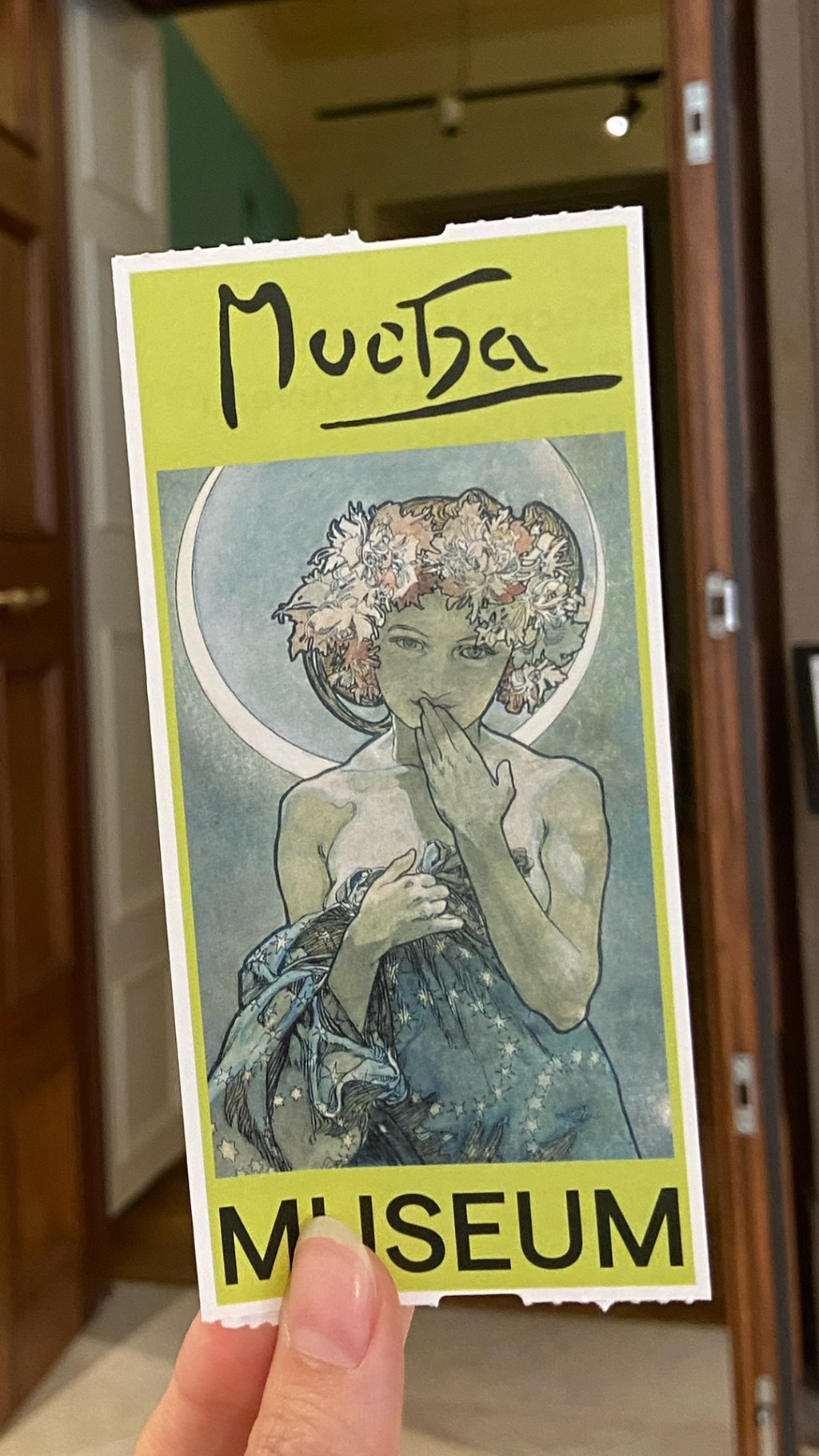
Arriving in Prague without set expectations, I was just happy to explore a new city and be surprised by the unexpected. The one thing I was looking forward to was seeing Mucha’s artwork. Then I found myself in a situation I’ve never been in before. I had to choose which Mucha Museum to visit. What? Can you imagine two rival van Gogh museums in Amsterdam fighting each other? Of course not, it sounds ridiculous. But that is what is happening in Prague with Alphonse Mucha’s work. There is the newly opened Mucha Museum, which the website mentions it’s endorsed by the Mucha Foundation. There is an older Mucha Musuem since 1998 that mentions they feature original artwork. Which one to visit?
I didn’t have time to visit both museums, unfortunately, even when they are so close to each other. I would have loved to compare, but I will refer to you, reader, if you visited the other one to tell me how it was. Or if you visit both, tell me your favourite. I ended up visiting the new Mucha Museum at SAVARIN Palace only because it was very close to my hotel, I had very bad internet available, and I didn’t realize the other museum was around the corner. Truly, my bad.

Since it’s a relatively small museum, I was able to leisurely explore and take my time. The exhibition is arranged into four sections: Mucha & His Homeland, ‘Le style Mucha’ & Art Nouveau, Mucha the Visionary, and The Slav Epic. I was able to go back and forth multiple times to the Art Nouveau section to admire the big panels showcased there.
Mucha was born in 1860 in Ivančice, Czechia. With interests in the arts, when he was 18 years old, he applied to the Prague Academy of Fine Arts and was turned down. He continued working at the court in Ivančice, supporting amateur theatre groups and illustrating for local satirical magazines. He also went to Vienna as an apprentice scene painter but was dismissed because a fire brunt down the Ringtheather, the biggest customer of his employer. It looks like fortune was turning her back on Mucha, but then, when he was around 25 years old and living and working in Makulov, painting portraits for a living, things changed. Fortune smiled at Mucha for the first time when he met Count Eduard Khuen-Belasi, who not only employed him to decorate two castles but also became his patron and sent him to the Munich Academy of Fine Arts, where he studied from 1885 to 1887. He also sponsored his studies in Paris where he continued his training at the Académie Julian and then Académie Colarossi.
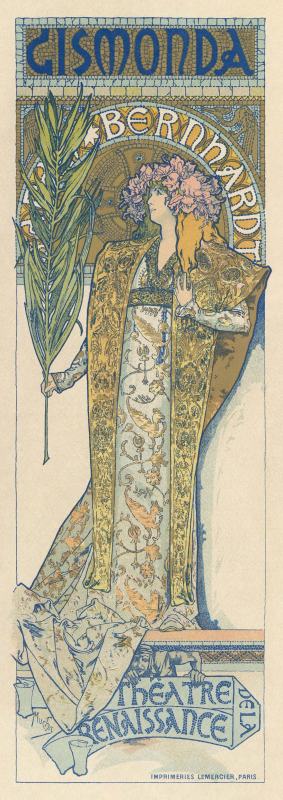
Good things don’t last forever, and in 1889, Count Eduard suddenly stopped paying Mucha his allowance. This was a great blessing in disguise because it forced Mucha to work for commercial books and magazines. Fortune smiled at Mucha a second time when the co-worker who was supposed to work on Sarah Bernhardt’s poster for Gismonda’s theatre production was on holiday. The poster exhibited in the streets of Paris on January 1, 1895, was such a big success that he immediately signed an exclusive contract with F. Champenois, a major Parisian printer and publisher. The poster collaborations he designed for Champenois established Mucha as the “Master of Art Nouveau”.
“Posters are a good way of enlightening the wider public,[…]. The streets became open-air art exhibitions” – Alphonse Mucha
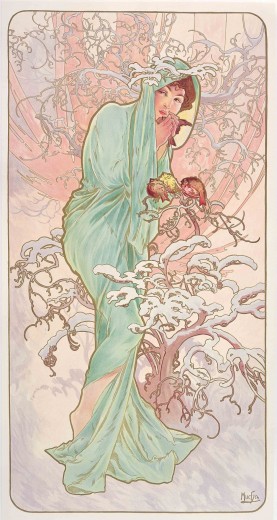

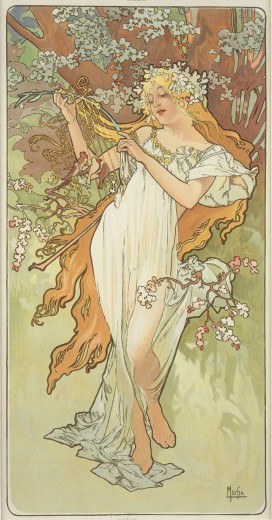
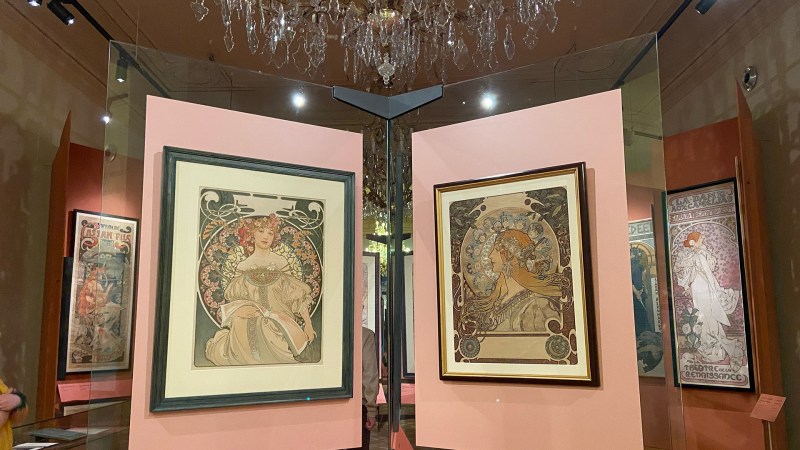
My favourite pieces from his Mucha Style are the ones he designed for The Salon des Cent and La Plume magazine. The salon was an exhibition venue by Leon Deschamps opened in 1894, promoting work from his magazine, La Plume. Mucha was invited to join in 1896, and in gratitude, he designed the poster for the Salon’s 20th exhibition. He exhibited 448 works at the Salon. La Plume not only showcased his work in the magazine but also organized a travelling exhibition that went to Vienna, Prague, Hradec Králové, Munich, Brussels, London, and New York, solidifying Mucha as an international success.
“The purpose of my work […] was to create, to build bridges. Because we must live in the hope that humankind will draw together, and that the better we understand each other the easier this will become” – Alphonse Mucha
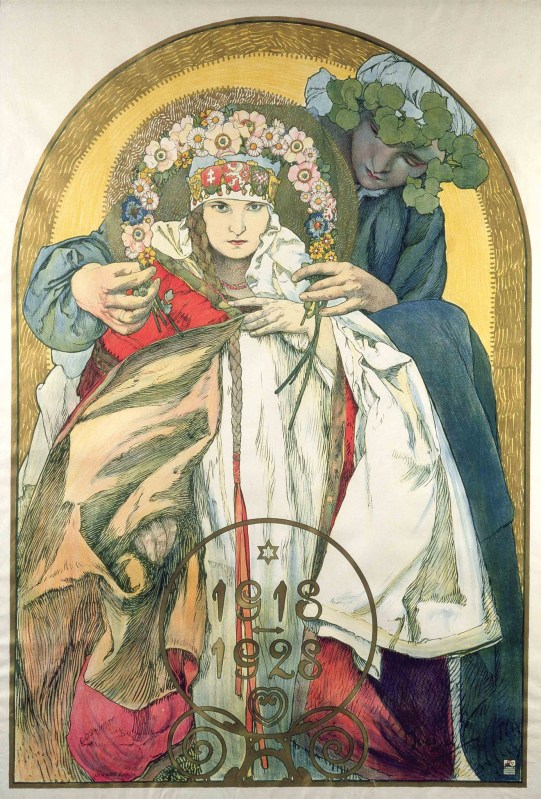
The section Mucha the Visionary shows his involvement with the masonic order in France. Mucha’s spiritual journey made him believe that the virtues: beauty, truth and love were the cornerstones of humanity. And through his art, he wanted to contribute to the improvement and progress of humankind. This inspired his masterpiece The Slav Epic, with the goal to inspire spiritual unity and political freedom. Consisting of 20 large canvases, it depicts the mythology of the Slavic people from its origin in ancient times, through the Middle Ages, the religious reformation, to the aftermath of the First World War, which brought independence from the Habsburg Empire. Mucha presented the complete series in the City of Prague in 1928 as a gift to the nation, coinciding with the 10th anniversary of its independence. I later found out that to see The Slav Epic you must visit the National Gallery of Prague.
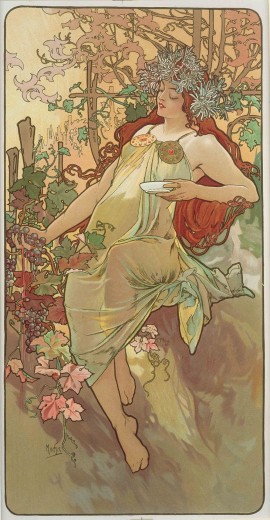
Absolutely loved learning more about Alphonse Mucha, he had the opportunity to use photo references for his work! How I wish I had visited the original older museum and also the National Gallery. But I won’t be too sad, maybe fortune will smile to me and I will get to visit again. My favourite Mucha Style Girls are The Seasons and The Arts, with a special mention to The Evening Star and The Moon. I have always been drawn to mystic cards, and these fit the theme perfectly. Art nouveau is one of my favourite art movements, so my heart was singing in happiness the whole time.
A Little Extra
- Take a moment to see this animation that is heavily influenced by Mucha. I wonder what he would think of it?
- Gift Shop Book. I’m really enjoying it, this is from a previous exhibition in the UK.
- Also bought a little handkerchief, a half plastic envelope, a postcard and a magnet. It was hard to resist, I did my best, I promise.
M
 MERIKKUMA
Leave a comment