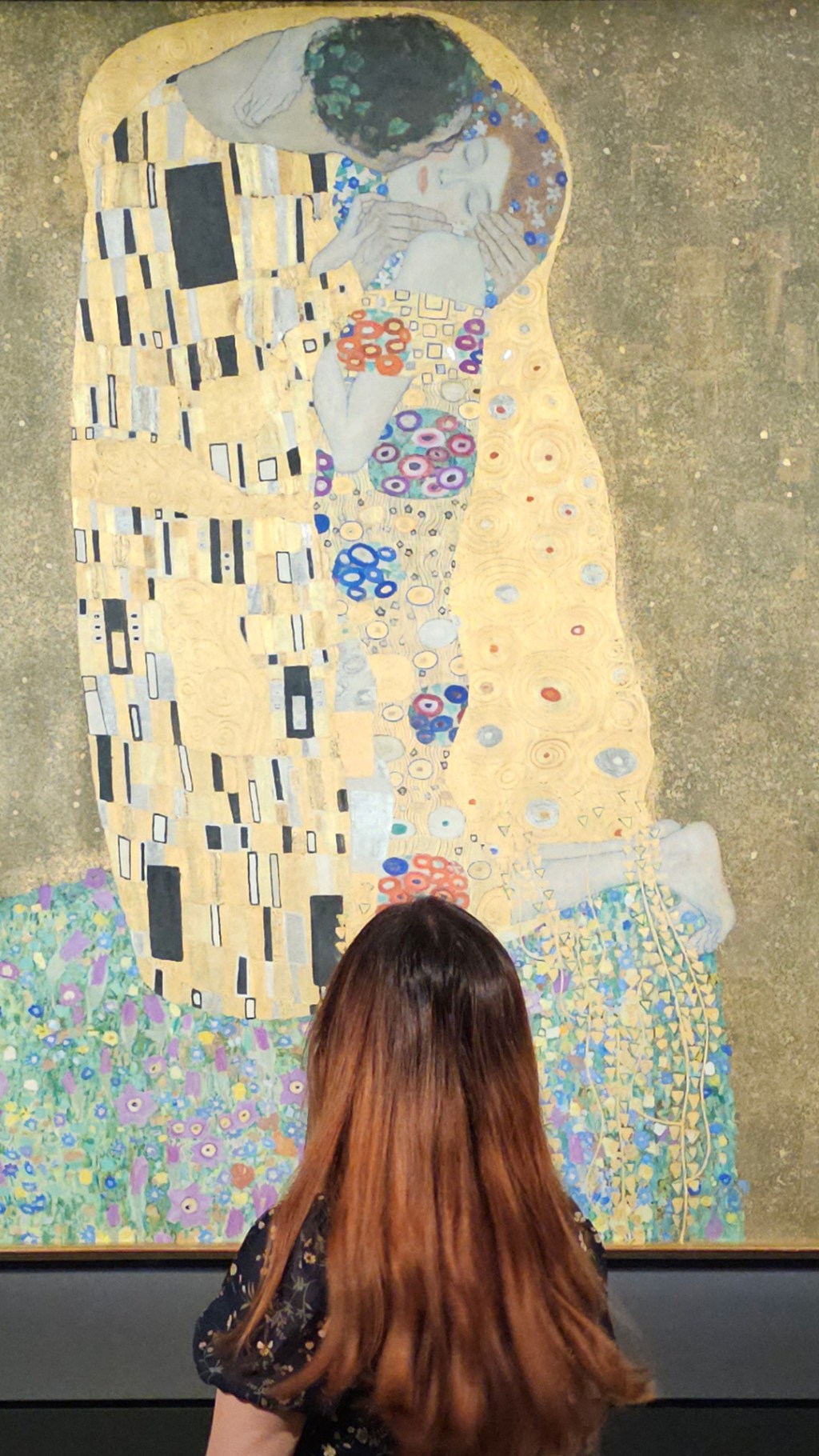
The Belvedere Museum is split into 3 buildings: Upper Belvedere which has a permanent exhibition, Lower Belvedere with special exhibitions, and the Belvedere 21, which has contemporary art. The buildings are all within walking distance, with beautiful gardens in between.
Upper Belvedere
I knew I wanted to see The Kiss several times, so I madly rushed to see it first. It was bigger than expected. It’s such an odd feeling when you finally see a piece you have been dreaming about. I circled back like 4 times looking for a quiet/calm time to discreetly take a photo with it. Nothing discrete about it when guide tours crowd a space, multiple cameras point at it, and everyone also wants a picture with it. Inevitably, you will end up ruining someone else’s photo, still, I tried and failed multiple times until it was done. I don’t usually take photos with masterpieces, I save that only for the ones I truly admire, this one was worth it. I’m grateful that at least it was possible, at the Uffici I had to give up on Botticelli’s La Primavera, there was no calm moment there.
Between visits to the lovers, I took my time to see the exhibition. I loved the section about female artists. It was empowering to see that many managed to break the glass ceiling and be recognized for their work. Among them were Tina Blau, Olga Wisinger-Florian and Marie Egner. There was also a surprise van Gogh on the first floor, always amazing brush strokes with him. We also saw a Munch’s Men on the Seashore, two Monet’s, Ferdinand’s Cats and Fish, and Jacques-Louis David’s Napoleon Crossing the Alps. All important pieces in art history. It’s a nice feeling when you see the original of something you saw in class or a textbook.
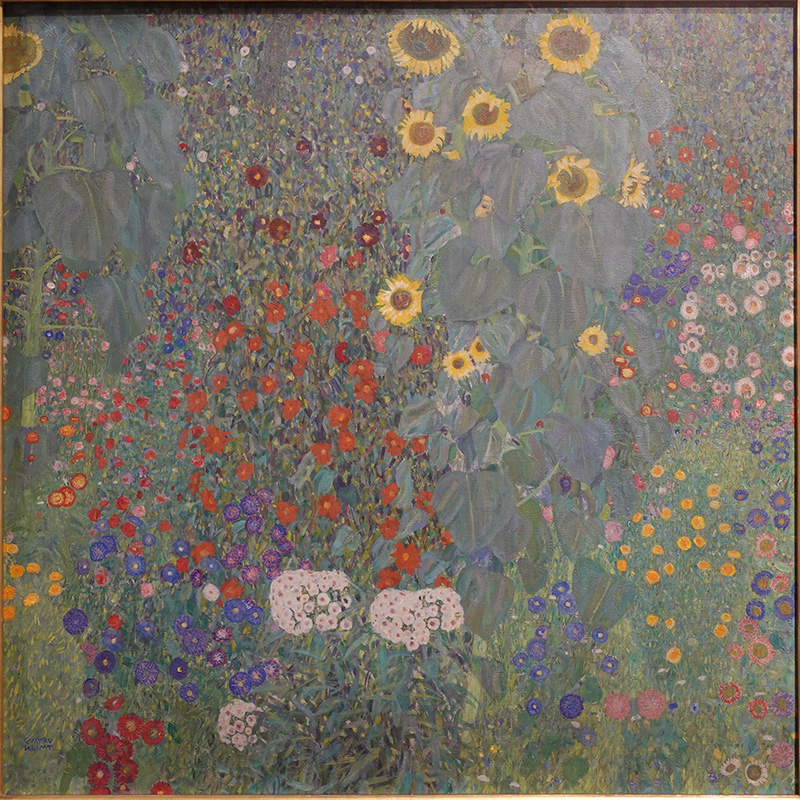

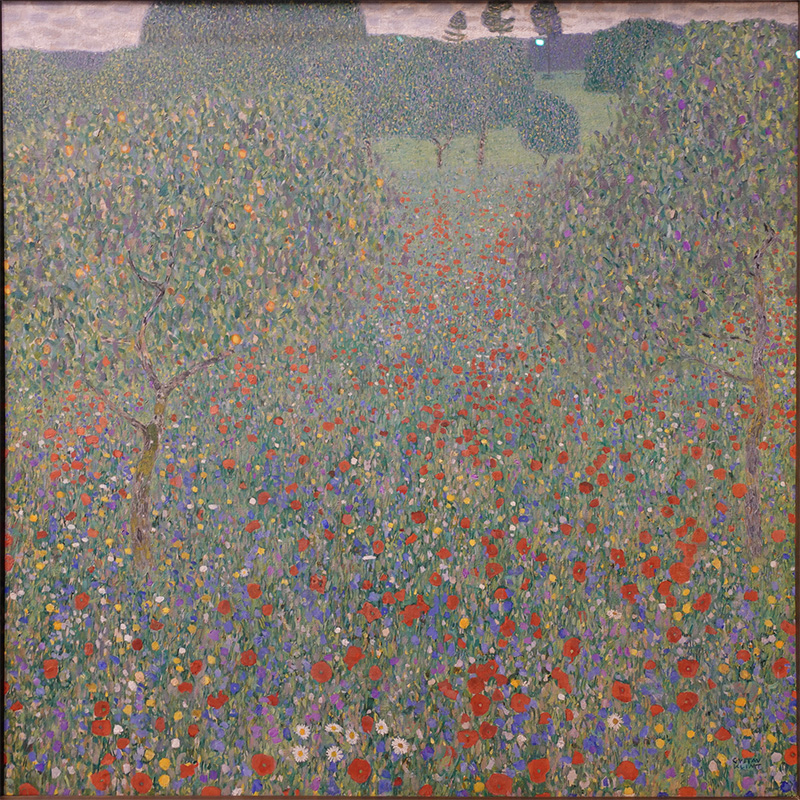
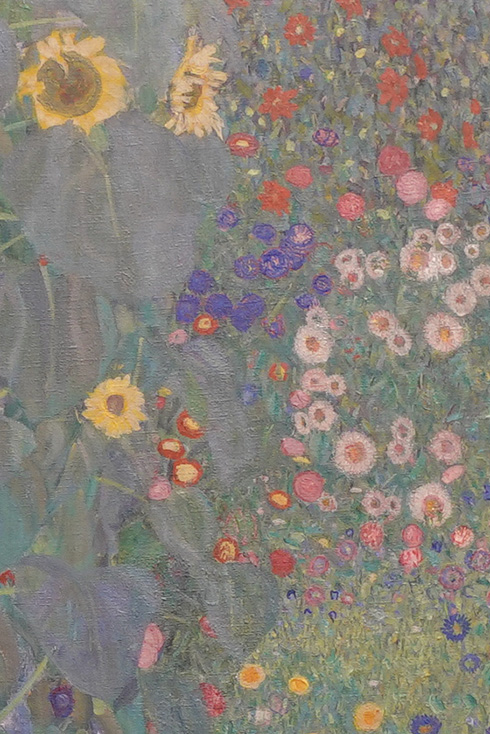
I was surprised to learn that Klimt preferred to paint in square canvases, reminding me of Instagram’s early days. All artists have a preference after all. The Lovers (which is the title bestowed by Klimt, aka The Kiss) is also in square format. He preferred a square format for landscapes, so the choice was interesting taking into account that this famous painting was not a commission! So it was truly his free artistic expression. He was also fond of using a viewfinder. I just love learning of the preferred process from artists I admire. I loved the pieces “Cottage Garden with Sunflowers” and “Flowering Poppies”.
An interesting correlation is that Klimt’s brushstroke techniques were described by art critic Ludwig Hevesi as “painted mosaics”. Before arriving in Vienna we visited Ravenna, famous for its Byzantine mosaics dating back to the 6th century. When we were in line for the Archiepiscopal Chapel our tour guide informed us that Gustav Klimt visited this chapel and was so moved and inspired by it that it influenced his golden period. So Ludwig was more on point in his critique than he knew.

Lower Belvedere
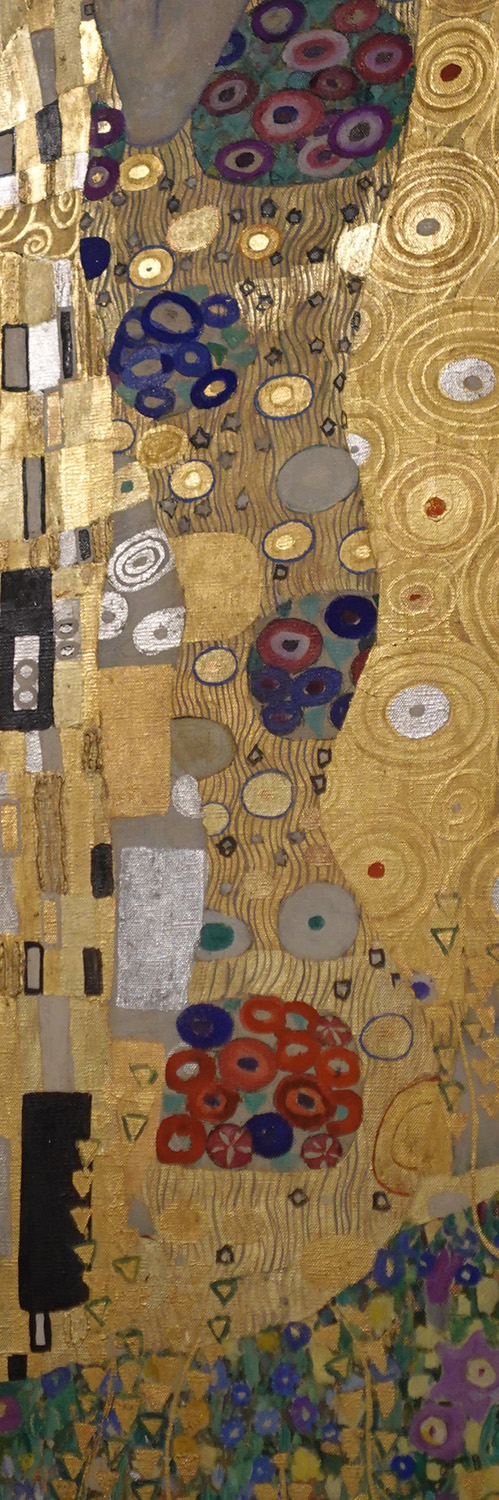
Gustav Klimt – Pigment & Pixel was being exhibited in the Orangerie. With the help of technology, they looked into the inner layers of paint to understand Klimt’s working process for his Golden Period. Klimt used the finest brushes, gold dust, and sometimes painted over already gilded areas only to cover them with gold again. In some paintings, he also used platinum (not only gold and silver), a very unusual choice at the time. In this exhibition, they have Judith on display. I love the effect Klimt uses for the skin tones, which reminds me of the impressionists. We could also see an infrared image of The Kiss.

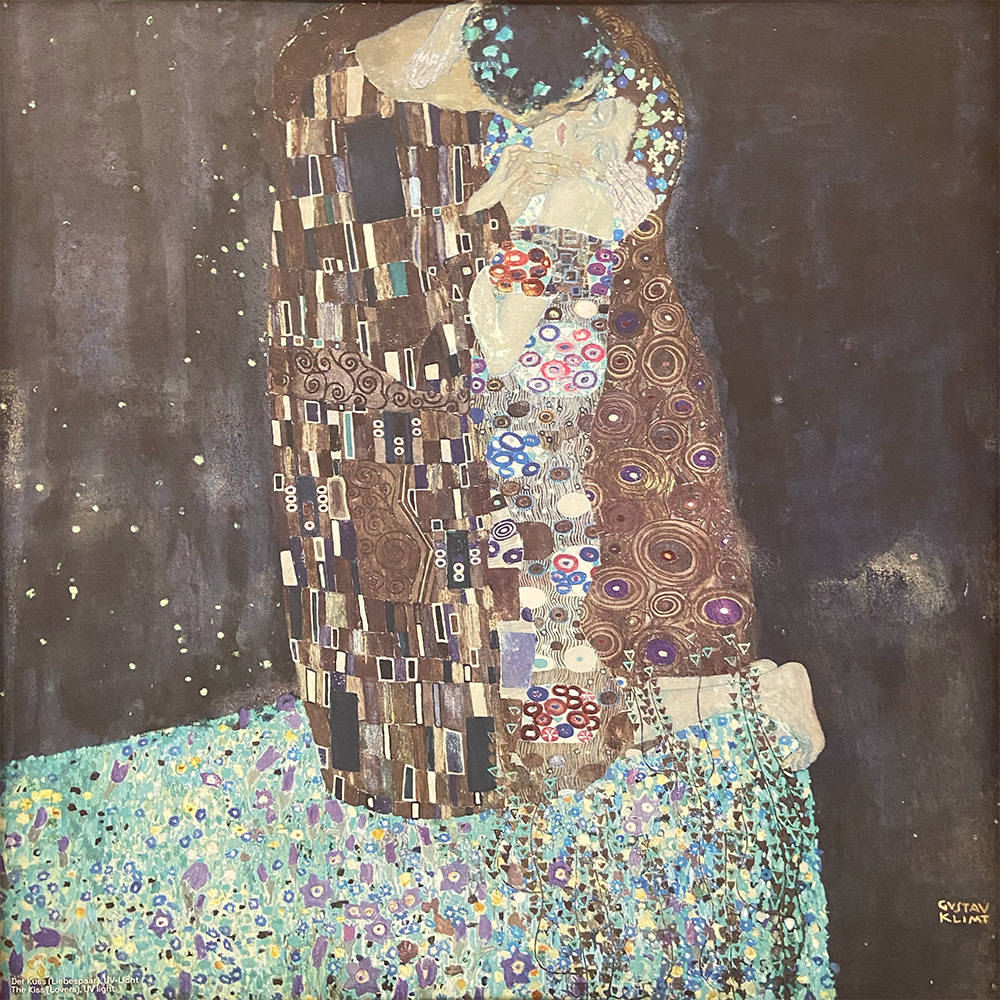

They also partnered with Google’s Arts & Culture to use AI to colorize the ceiling of the Great Hall of the University of Vienna paintings destroyed in a fire in 1945, based on black and white photographs. I am very conservative with my point of view of AI creating art. I think this was an interesting use of AI to analyze an artist’s legacy and try to guess the colors he might have used based on black-and-white photography. In this case, the algorithm is making informed guesses, not creating art. Very interesting!
The colorization was done using machine learning developed by Emil Wallner. The museum stated that his project doesn’t claim to be an authentic reconstruction; just an approximation of the original colors. The museum printed the results in its original size as well.
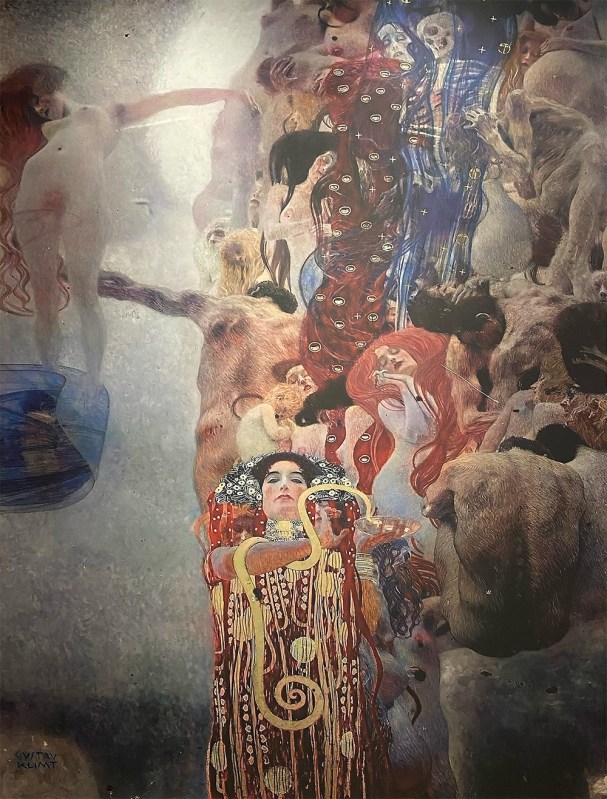
According to the museum description, Klimt decided to portray humanity as powerless against fate. The goddess of health Hygieia in greek mythology is in the center symbolizing medicine, she is holding a glass bowl where an Aesculpian snake is drinking, while she is looking directly at us. On the right Klimt depicted sickness and death. Ahead of its time, when the cieling was presented to the public they were offended by the erotism in the art piece.
Belvedere 21
The contemporary exhibition was very thought-provoking. Hans Haacke’s political conceptual art exhibition “Retrospective” addresses abuse of power, mechanisms of exclusion and inequality, exposes corporate greed, and the accomplice of public institutions. These exhibitions really shocked me, they feel more relevant than ever. I’ve added below three extracts from the museography because I don’t want to bias the pieces with my paraphrasing. I think it’s already well described, this way you can come to your own conclusions.
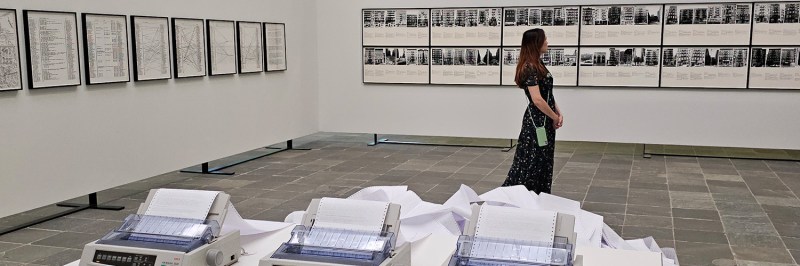
In 1971, the Shapolsky real estate group,headed by Harry Shapolsky and nominally owned by about 70 diferent corporations, frequently bought, sold, and mortgaged properties within the group. What amounted to self-dealing had tax advantages (mortgage payments are tax deductible) and obscured the actual ownership of the properties. The boards of these seventy odd corporations each included at least one member of the Shapolsky family or someone with close ties. The 142 known properties were located predominantly on the Lower East Side and in Harlem—both slum areas of New York City in 1971—where they constituted the largest concentration of real estate under the control of a single group. The information for the work was culled from public records at the New York County Clerk’s O ce. Thomas Messer, then the director of the Solomon R. Guggenheim Museum, rejected this work and two others that had been made for a solo exhibition at the museum. He cancelled the exhibition six weeks before the opening when the artist refused to withdraw the disputed works. Messer called them “inappropriate” for exhibition at the museum and stated that he had to “fend o an alien substance that had entered the art museum organism.” Hans Haacke, 2006
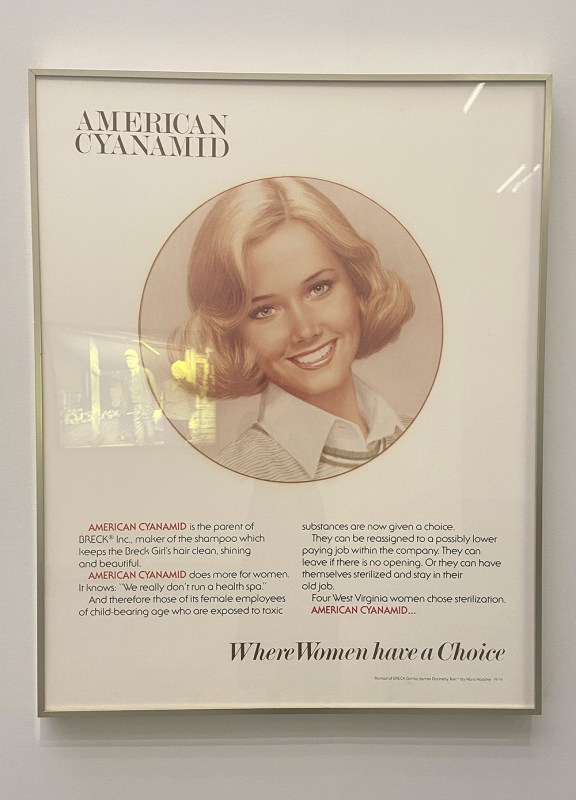
Hans Haacke “The Right to Life”, 1979
The Allied Chemical Corporation, like American Cyanamid, has required the sterilization of female employees of child-bearing age if they wanted to continue in certain jobs. Two women have undergone the operation. Other large chemical companies have also practiced “protective discrimination,” usually restricted to moving women of child-bearing age into lower paid jobs within the company, where they are not exposed to toxic substances. Reported among these companies are Dow Chemical, Monsanto, DuPont, General Motors, Bunker Hill Smelting, St. Joseph Zinc, Eastman Kodak, and Firestone Tire and Rubber. In 1980, several women a ected by American Cyanamid’s “fetal protection policy” sued the company. After three and a half years of pretrial proceedings, the case was settled for $200,000, plus costs and attorney’s fees. In another lawsuit against American Cyanamid, the U.S. Court of Appeals for the District of Columbia, in an opinion authored by Judge Robert Bork (appointed by President Reagan), ruled that making sterilization a policy for a job didn’t violate the Occupational Safety wand Health Act. This law stipulates that an employer must provide a safe workplace. American Cyanamid is a diversified multinational corporation with headquarters in Wayne, New Jersey. Among the company’s better-known perfumes are Temps, Niki de Saint Phalle, Pierre Cardin, and Geo rey Beene; it also makes Old Spice aftershave for men. Hans Haacke, 1986
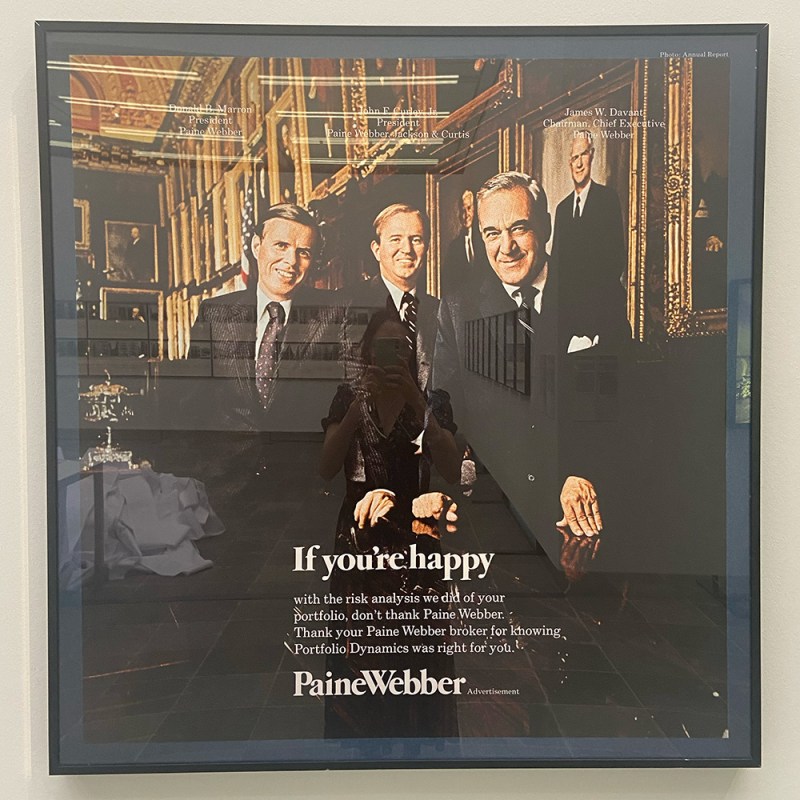

Hans Haacke “Thank you, Paine Webber”, 1979
After 30 years, Thank You, Paine Webber gained an unfortunate new topicality. The exploitation of people’s misery—in this particular case, for PR purposes, but indicative of corporate attitudes and behavior more generally—continues unabated. The use of a photo of an unemployed worker from Detroit during the Great Depression on the cover of a powerful brokerage firm’s 1977 annual report is a telling sign of how ingrained this “culture” really is. The lead essay in the 1977 annual report had the promising title “Where Do Jobs Come From? A Concise Report on Unemployment and Wall Street’s Role in Preventing It.” A year later, the annual report offered another enlightening piece: “Do You Sincerely Want to Be Poor? Paine Webber’s Centennial Essay on the Future of American Capitalism.” At the opening of the new millennium, Donald B. Marron, the smiling young man on the left in the group photo of the Paine Webber 1977 annual report, led the merger of his brokerage firm with UBS, the giant Swiss bank and wealth manager. During his twenty years as CEO of Paine Webber, Marron amassed a substantial corporate art collection. The Museum of Modern Art in New York opened its new building in 2005 with an exhibition of this collection under the UBS logo. It so happened that Marron had been the president of the museum’s board of trustees for many years and, in 2005, was its vice president. Hans Haacke, 1986/2019
Quotes by Belvedere 21.
Overall it was a very engaging museum, with many masterpieces and excellent museography explanations. I had a great time and left very happy. The gift shop has excellent options as well. I got The Kiss socks, a pin, a postcard and I couldn’t help myself and also got a cushion cover of the Flowering Poppies. It was just too beautiful!
M


 MERIKKUMA
Leave a reply to Merikkuma Cancel reply